

[To listen to this piece being read by Malika, click here to access an audio recording. Patience is a virtue :) … It might take a moment to load.]
My mother and I were very close. She loved my sister and me dearly, and was a great mom, but she was also much more than that. As I entered my late teens and twenties, she became a close friend and soulmate. To me, her brilliance radiated. When we would link arms and walk in Georgetown, or through the wooden trails of Arlington, Virginia, our conversations had a way of making me feel settled and at ease, while simultaneously lighting my curiosity and passions on fire. It’s no exaggeration to say that my mother became a beacon of both intellect and heart in my life. So, when she began her descent into a spiritual crisis and depression that eventually lead to her death — I too began my own descent, and it remains the most harrowing and transformative time of my life.
I can’t emphasize enough how unclear it was to me that I would survive it. I didn’t have thoughts of harming myself, but I was frightened by the depths of my sadness and pummeled by the strength of my anxiety. Grief seemed interminable, which only fueled my terror that it would “always be like this.” I felt flattened by suffering — mine and that of the world. Despair was a regular visitor, especially at night. My access to matrilineal, feminine wisdom seemed cut-off, and I felt totally ill-equipped to cope with powerful psychic energies coursing through me. My disorientation was exacerbated by not knowing what was happening to me, not knowing what descent was, let alone what to do about it.
A descent is like that. A descent is not just a bad day or year. No. It is when the ground of our psyche and life shifts and dissolves so dramatically, that a self-emptying, conversion experience takes place — dropping us into a totally new reality that is scarily unknown to us. Some people call this the “dark night of the soul,” a term coined by John of the Cross, which is an apt name because descent is when the soul moans, aches, and empties before pulling (or dragging) us into a new relationship with the cosmos. All descents entail discomfort. All of them. They are inherently initiatic, but many initiations fail when people regress, refusing the change demanded by the depths. Descents are about dissolution, and they can be intense and petrifying.
I was fortunate. Prior to my own descent, as if unconsciously sensing its approach, I had begun to deepen my spiritual practice, launching myself into study and meditation. Once the descent made conscious land-fall, I prayed for guidance and for teachers. As if by magic, they seemed to find me — in person, over the radio, and in books. My descent arguably lasted for six years, and by the end of it, not only had my mother died, but I had moved across the country, gotten a divorce, and left my career as a lawyer to work with the dying as a Chaplain. But in the middle of it, none of those directional shifts were fully apparent to me. I was walking (more like crawling) blind. And there was a good chunk of it where I was really afraid.
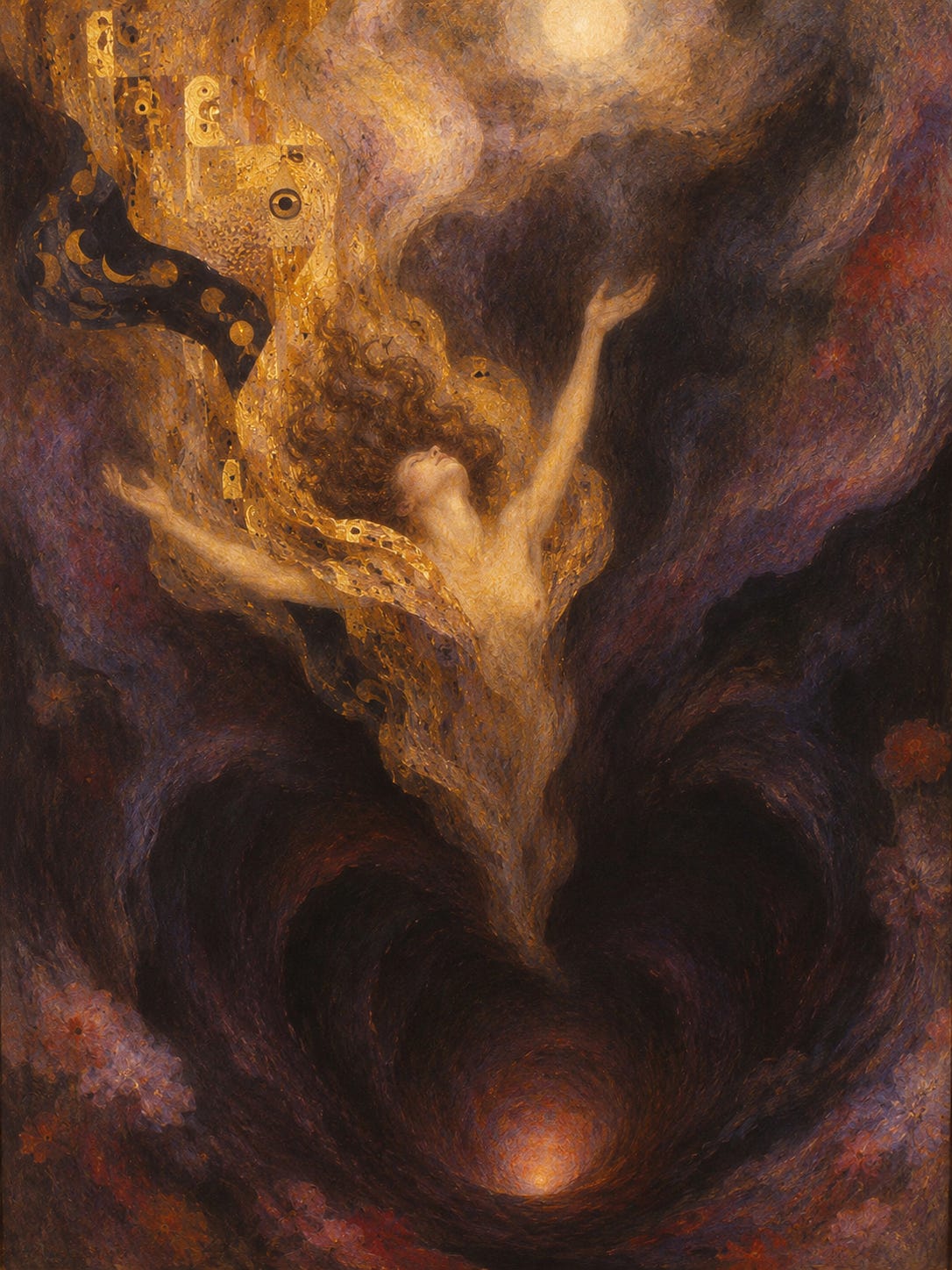
Today, as a professional Chaplain and Spiritual Counselor, I walk with people going through descents. I have the utmost respect and humility for how strong and difficult they can be, but do my best to point out key features of the landscape, so as to encourage a conscious receipt of the descent experience. And when it comes to navigating descent, that’s really what it’s all about: receiving it. One cannot master, obliterate, or control a descent through ego-will, but one can cooperate with the downward, energetic direction with eyes wide open. Conscious receipt of descent is what helps us receive its eventual gifts.
Yet receiving groundlessness is no easy task. People can die from descent when they receive no guidance or the wrong guidance. At the same time, there is no foolproof “how to” manual when it comes to descent because it’s not a linear process. Still, having personally gone through a few descents over the years, and having supported others through theirs, I can say with confidence that approaching descent with wisdom is possible. That’s precisely the aim of this blogpost and the “Descent Guide” series it’s kicking off: to share the wisdom that can help you relax into descent with courage and consciousness, even as the ground dissolves beneath your feet.
Descents: Getting Clear About What They Really Are
Descents are characterized by something dying or coming to an end. But what is that “something” exactly? Remember: descents are not just a bad day, week, or even year; and despite the fact that loss and grief are a part of any descent, a single loss, however profound, is not in-and-of-itself a descent. Rather, a descent is when a major sense of coherence about life is dying. The world (inner or outer) used to make sense but something has shifted, and the old order starts breaking apart and dissolving. Said another way, descents happen when a major way psychic energy was organized is no longer tenable. A new sense of coherence is needed. In short: a descent takes place when reality has outsized your old organizing principle. It is the dissolution of the old order of coherence that is no longer viable given the directionality of change.
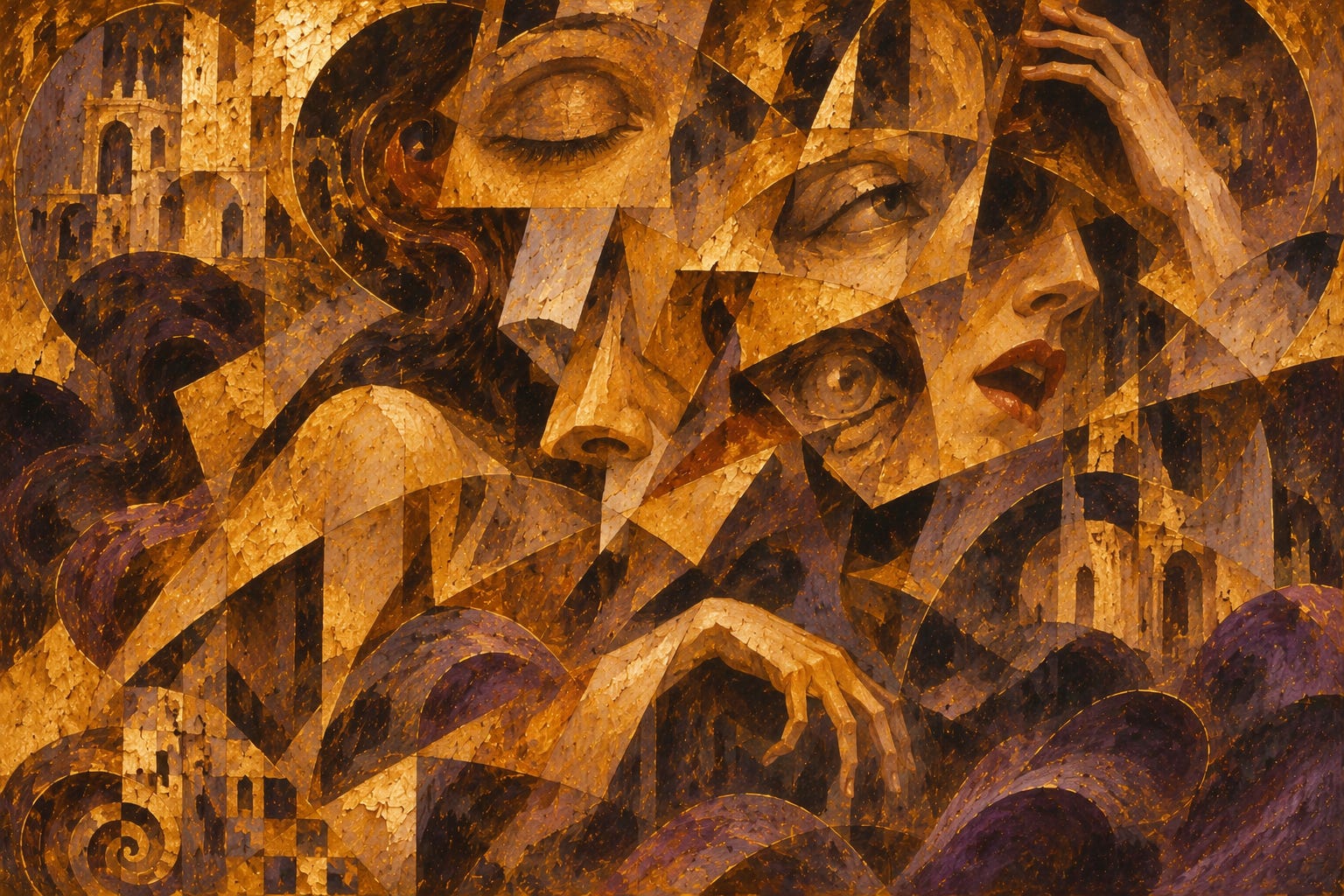
When my mother died, my sense of morality; my sense of being in control of my fate; my sense of safety; and my ontological understanding of WHAT reality fundamentally is — it all began to fall apart. Yes, grief was an inextricable part of my descent — I missed my mother’s smell, company, presence, touch, and voice more than I can explain — but it was the way my mother’s death blew apart my then-existing sense of spiritual coherence (about who and what I was in relation to the world) that initiated my most profound period of descent.
Descents: Individual and Collective
Individuals go through periods of descent, but so does humanity as a whole. And I think it goes without saying that, right now, we’re in a collective descent. Regardless of whether you think this descent is comparable to — or worse than — previous descents in human history, the general wisdom lately is that yes, the old order is dying. We have entered a disorienting, liminal time and the future is entirely unclear. Institutions seem to be on shaky ground or actively falling apart; conventional religious images are no longer sufficient to capture the projections of the wisdom within; young adults are understandably scratching their heads about what a post-ai life trajectory looks like; disparities in wealth are at their worst in history with more people than ever at the brink of homelessness; and there is a general sense that societal trust and agreements about values, identity, and history are all eroding. And regardless of whether you were relieved or distraught by the outcome of the 2026 midterm elections in the United States, the power swing does not negate descent. The old way of doing our human business is no longer possible, and the path forward is not yet clear. What has been neglected in the underworld is now beginning to stir, calling for a new order that is wide enough to hold it.
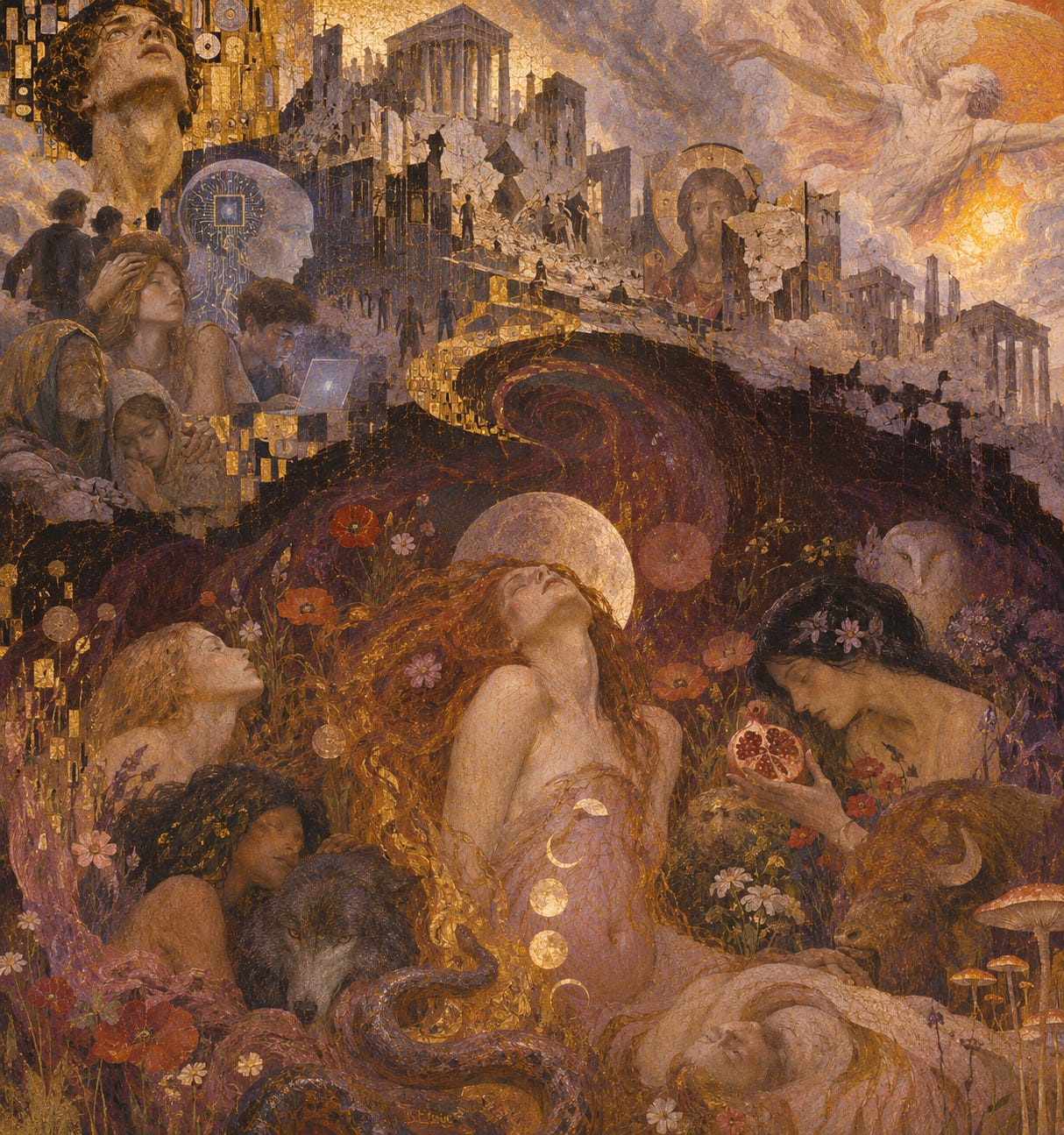
I was at a Jungian conference last year, and many of the presenters described what we could expect to see psycho-somatically (at the individual level) as this collective descent unfolds: increased agitation, inexplicable exhaustion, panic, edginess, anxiety, despair, and more people fearing losing their minds or becoming overwhelmed. Peachy stuff. Many of the most sensitive and intuitive among us, can feel the collective descent, or see it in our nighttime dreams, whether or not we are going through an individual one at the same time.
But it’s also entirely possible to be going through an individual descent while this collective descent is happening, which is a definite double-whammy. When this happens, accessing wisdom is all the more important. The conventional culture can generate quite the psychic rip tide of distraction, taking us far afield from the inner work we need to do. It pummels us with propaganda about who is to blame, with addictive dosages of fear, or with a deluge of sheer banality that mutes our feelings all together. Sometimes it takes all our courage to abandon the bright lights, to look inwards, and trust the dark.

Wisdom Transmission #1: Situate the Descent Within Its Larger, Cosmic Pattern
Creation-Dissolution-Creation
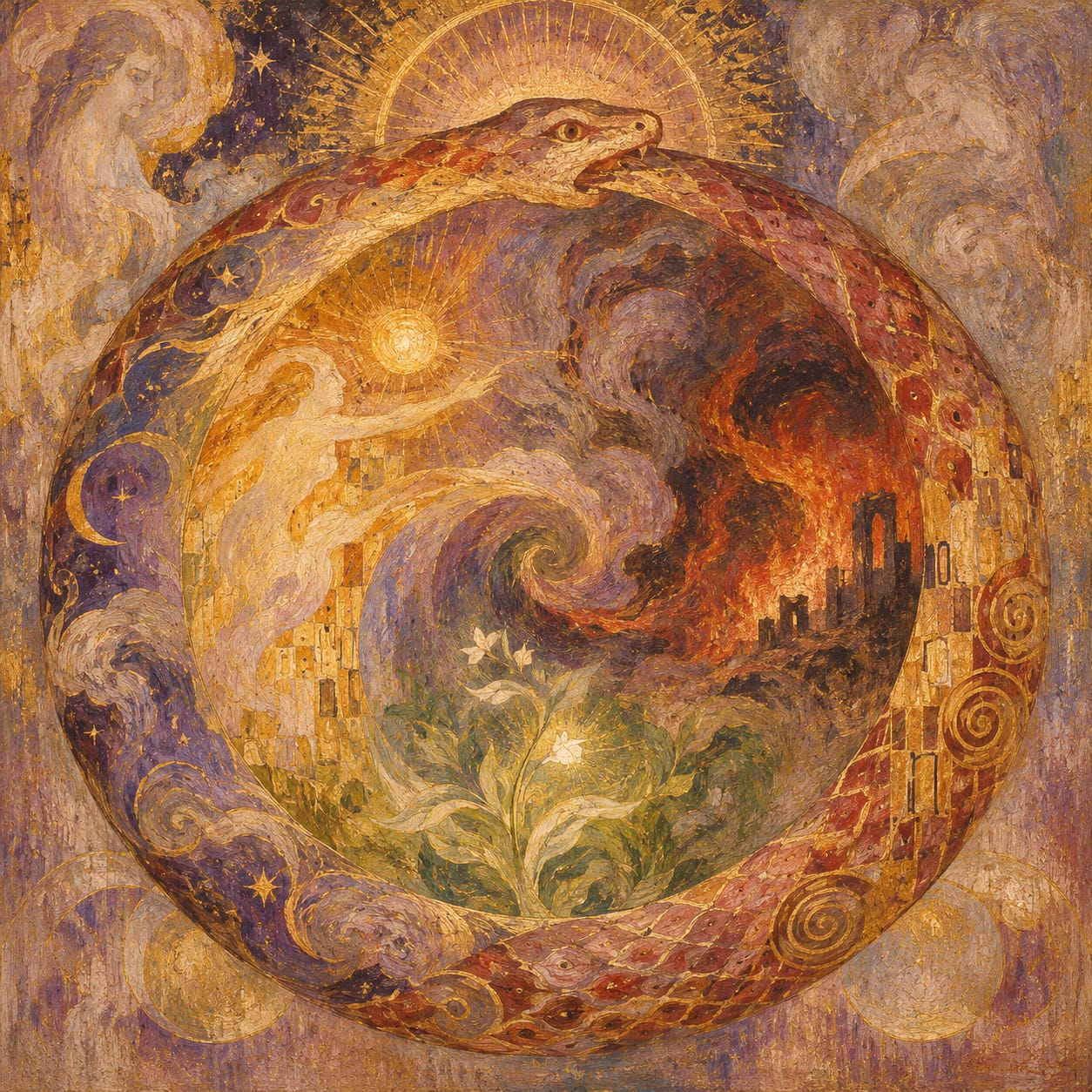
Whether it is a personal time of descent, or a collective one, in my experience the first lifeline comes from “zooming out” so as to contextualize the descent within a greater, creative cycle — a cosmic pattern of dissolution and generation that is depicted in both mythology and nature. Jungian analyst Clarissa Pinkola Estés calls this the “life-death-life” pattern, where death of the old is not the end, but simply the condition precedent to the new. This cosmic pattern is the case whether we’re talking about the natural world, or the individual and collective psyche. Symbolically, this pattern is represented by the ouroboros, the yin-yang, the spiral, the mandala, the scarab, and Buddhist wheel of Becoming (bhavachakra), to name only a few. Christianity celebrates the same cosmic pattern in terms of creation, death, and resurrection, where the crucifixion is a disturbing time of grief, disorientation, and liminality preceding resurrection into new life. (Note that the true meaning of “apocalypse” in Greek is “revelation,” pointing to an end that lifts the veil of the new beginning, rather than a nihilistic descent into nothingness.) This life-death-life pattern is embedded in virtually all religious narratives. The core Hindu pantheon of Brahma (the Creator), Vishnu (the Preserver), and Shiva (the Destroyer) points to the braiding of transpersonal forces. Descent is only part of the cosmic play; the Destroyer is not a mono-God.
Many years ago, during my first few days of my first Chaplain internship at a hospital, I recall getting paged to the emergency room. A woman had attempted to end her life by driving her car off a nearby mountain. The car was destroyed, but somehow, she had emerged with only minor injuries. She had already spoken with the on-call psychiatrist and subsequently, had asked to speak to a Chaplain.
When I arrived, I saw a woman in her early fifties, with a few cuts on her knuckles and face, looking pale and frightened. Her hands shook as they held a waxed dixie cup, half-full of hospital-provided apple juice. I asked if it was alright to sit with her, and she agreed, but in the same breath explained to me that she was “not at all spiritual or religious.” I learned that her name was Barbara, and that her only son had just moved away to a university campus across the country. As a stay-at-home mom for the last eighteen years, she reported that all she had now was a strained marriage with a husband that she had long-suspected of having an affair.
At first, I did what Chaplains do: sticking to questions to provide Barbara a chance to hear herself, to voice her hurt, to perhaps discover her own wisdom. And yet, it was soon clear that Barbara had no mythology to help her contextualize the death of her core identity as a mother and caregiver, nor did she have one that could help her abide in the descent long enough for the psyche to re-invent itself. This was not her fault. In a world so grossly focused on the material plane, and so out-of-wack in its obsession with endless, linear progress and growth, it can feel impossible to trust an unseen death-regeneration process, especially when something so central to one’s life is falling away.
We had to contextualize Barbara’s descent in a way that made it feel workable. As I looked out the window for a moment, I remember wondering how the hell to approach a spiritual dilemma of meaning and purpose without a mythos — without the narrative and language of spirituality that Barbara had already voiced she found repugnant.
Thank goodness the trees were generous that day, and a few caught my eye. I found myself asking Barbara, “What’s your favorite season?”
“Summer,” Barbara said.
We had just entered autumn, but several of the trees were already almost bare. I pointed to them and said, “I guess it’s not summer anymore. Sometimes that happens so quickly, I lose my bearings.”
And with that, we slowly began to explore the seasonal transition as a metaphor for the happenings of her psychic life. Together, we held the tremendousness of the dissolution of Barbara’s identity as a mother of a child — a child who, thanks to her care, had now become a capable adult who no longer needed of the type of nurturing she had offered him for so long. I described the winter of descents, just as so many mysterious teachers had described them to me: how they function, and how total the loss of coherence can be. Eventually, after tears, long pauses, and breaks for hospital saltines and graham crackers, we even began exploring what might help her trust the stirrings of a new spring and summer in her life.
But my most precious memory of Barbara is that, at some point during our conversation, she took out a piece of paper and pen from her purse and said, “Draw it. Draw a descent.” And so, I did my best to trace a simple life-death-life arc on a piece of paper, circling a portion of the downward slope where I believed she was located. Barbara then took hold of the paper. She jotted notes about the nature of descent; wrote down what she imagined would still have to fall apart in the near future; and finally, pictorially drew what ascent into the spring of her new life might look like (which included, as I recall, moving out of her marital home, and connecting more closely with her two sisters). She folded up the paper and put it in her purse, and before expressing her readiness to leave the hospital said, “I know this is going to be awful. But, I’m so relieved to have a map.”
I never found out what happened to Barbara. I don’t know if she survived her descent or not. But, what I do know is that during our time in the emergency room together, she came to understand that what she was suffering was not as simple as her son moving out. She was able to claim the descent by realizing that her old life was gone. She saw that her “empty nest syndrome” was no small threshold, but rather a total collapse of coherence about her sense of identity and life purpose. She learned that, yes, this does happens, just as trees really go bare as the summer fades away. Barbara was able to contextualize her own suffering within a cosmic reality pattern.
Initiation: The Archetypal Rite of Passage from the Old to the New
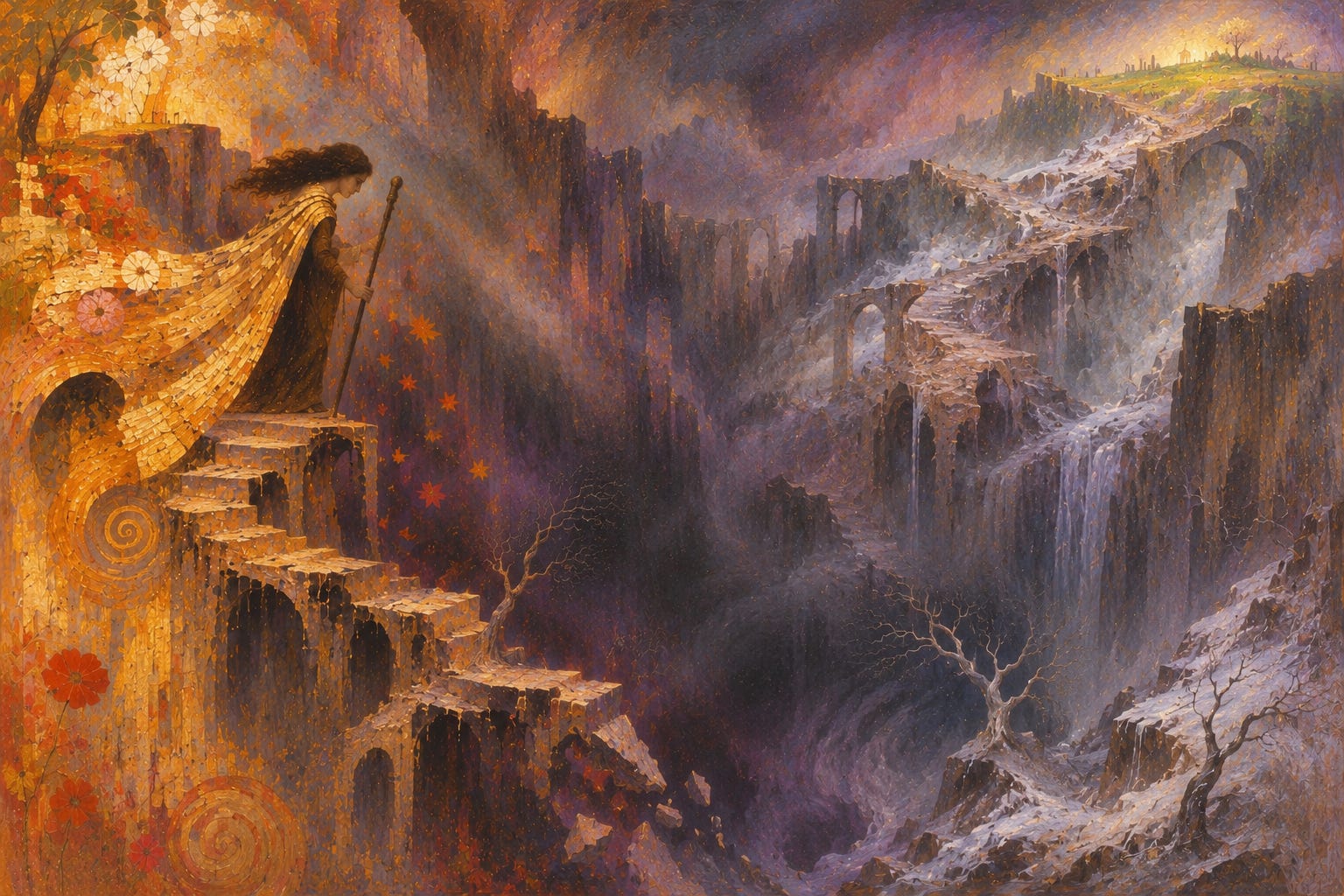
Another way to locate descent within a cosmic reality pattern is to see it through the lens of initiation. After all, that’s exactly what a descent is when we “zoom out” to see the whole picture. Initiation is not separate from the creation-dissolution-creation reality pattern; rather: it’s implicit within it. That is to say, without denying the cyclical nature of life-death-life, initiation provides a slightly different vista on the same reality. From the point of view of initiation, descent is part of a personal rite of passage into the new. An initiatory lens emphasizes the journey of navigating life’s critical thresholds, which, once crossed, lead to new, expanded versions of self.
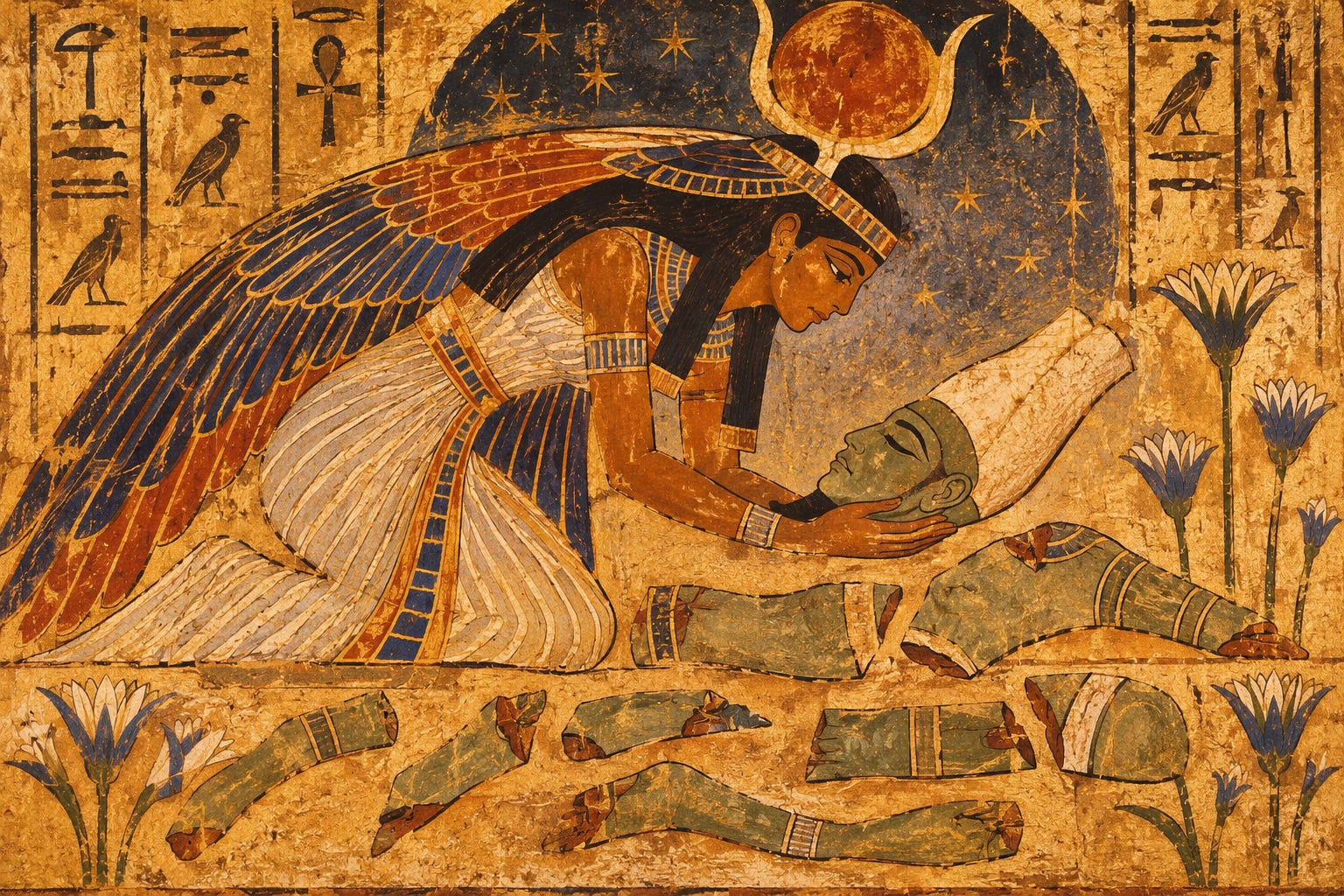
Whether we’re talking about initiations into stages of life (like adulthood or elderhood), or the initiations into psycho-spiritual realities (like the underworld or the transpersonal), all initiations involve a three-fold process: (1) the relinquishment of the old identity; (2) a disorienting, liminal period where one is neither “this” nor “that;” and (3) an eventual discovery and integration of the new. This pattern is replicated in countless initiatory myths (the myths of Isis and Osiris, Persephone and Demeter, Vasalisa, Beauty and the Beast, Inanna and Ereshkigal to name a few), and as Arnold van Gennep and many other anthropologists have pointed out, it is also a pattern replicated in formalized initiation ceremonies around the world.
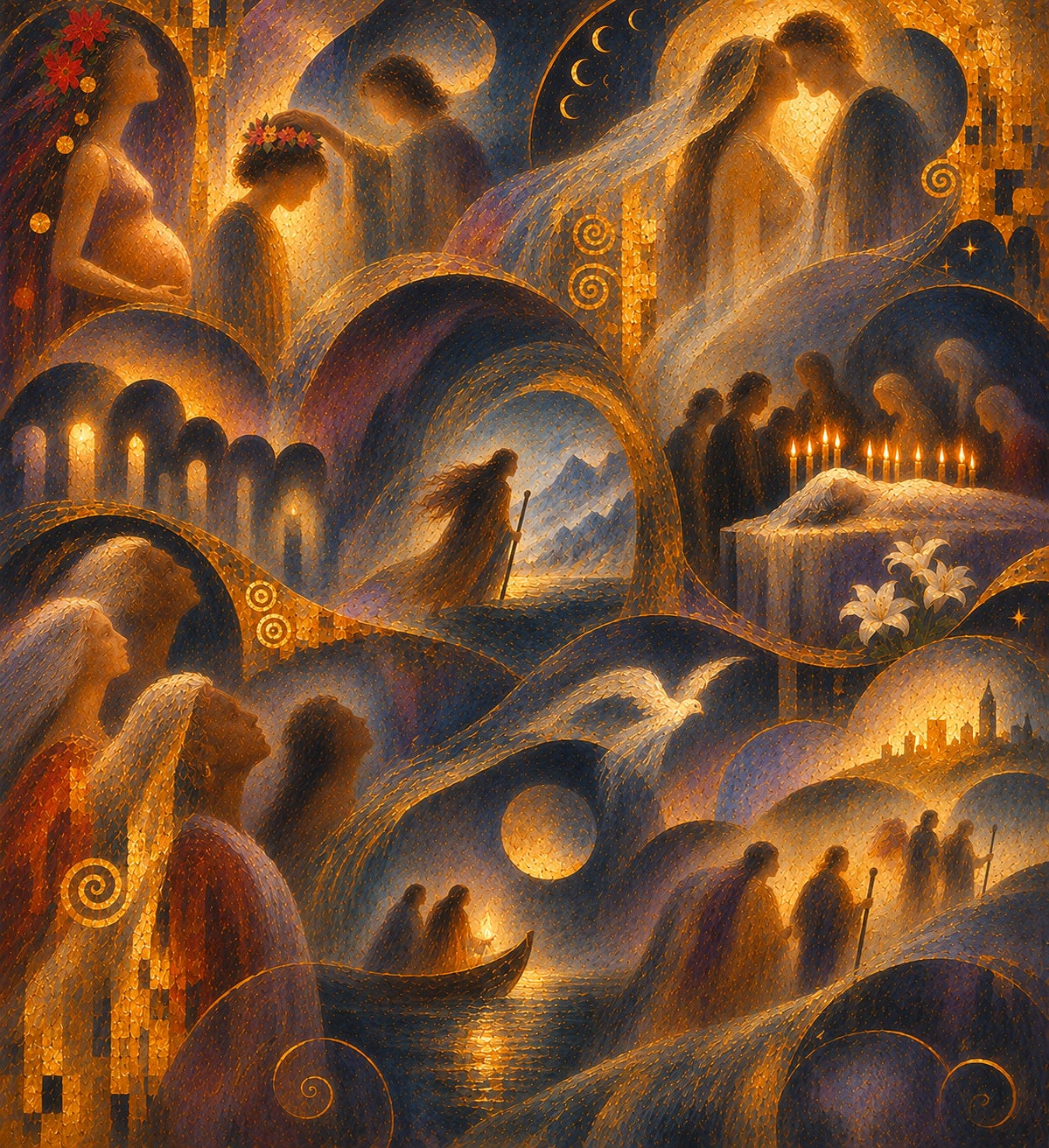
If all initiations involve a process of (1) letting go of the old; (2) navigating liminality; and (3) inhabiting the new, we can locate descent as the first and second part of this three-fold rite. Yes, a descent is when there is a collapse of coherence — when the old identity, the old way of living, or old way of understanding reality is no longer tenable. But it is also a dark and chaotic time of meandering through liminality when the old state of affairs is no longer accessible to us, but the new modus operandi is not yet apparent. This framing helps us see the twofold challenge of descent. The first challenge is letting go of the familiar. But the second challenge is enduring the lack of coalescence of the not-yet-born. We are being psycho-spiritually dismembered and reorganized, but the blueprint of the final picture is not available to our conscious minds. In my experience, it is during this liminal stage that people think they are going crazy and start to panic. There is a fear that one is lost and may be lost forever. And yet, as Clarissa Pinkola Estés alludes to: all descents into initiations promise that we will know something we did not know before. But, in the middle, we have no idea what that “new knowing” will be, nor who will know it!
This is why it is so powerful to reframe a descent as an initiation. Doing so helps us endure the inherent discomfort and suffering of descent by infusing the entire experience with its larger meaning. There is an art to locating difficulty in the grander cosmic schema. In the chaplaincy and spiritual counseling context, this art is often called “meaning-making,” but it is more like “meaning mining” — a discovery and receipt of the deeper coherence at play. Jungian analyst and M.D., Edward Edinger, describes this art as the transformation of a symptom into a symbol. He writes:
“A symptom can be transformed into a symbol through awareness of its archetypal foundations. Every symptom derives from the image of some archetypal situation. For instance, many anxiety symptoms have as their archetypal context the hero’s fight with the dragon, or perhaps the rites of initiation. To be able to recognize the archetype, to see the symbolic image behind the symptom, immediately transforms the experience. It may be just as painful, but now it has meaning. Instead of isolating the sufferer from his fellow humans, it unites him with them in a deeper rapport…Almost any difficulty can be borne if we can discern its meaning.”
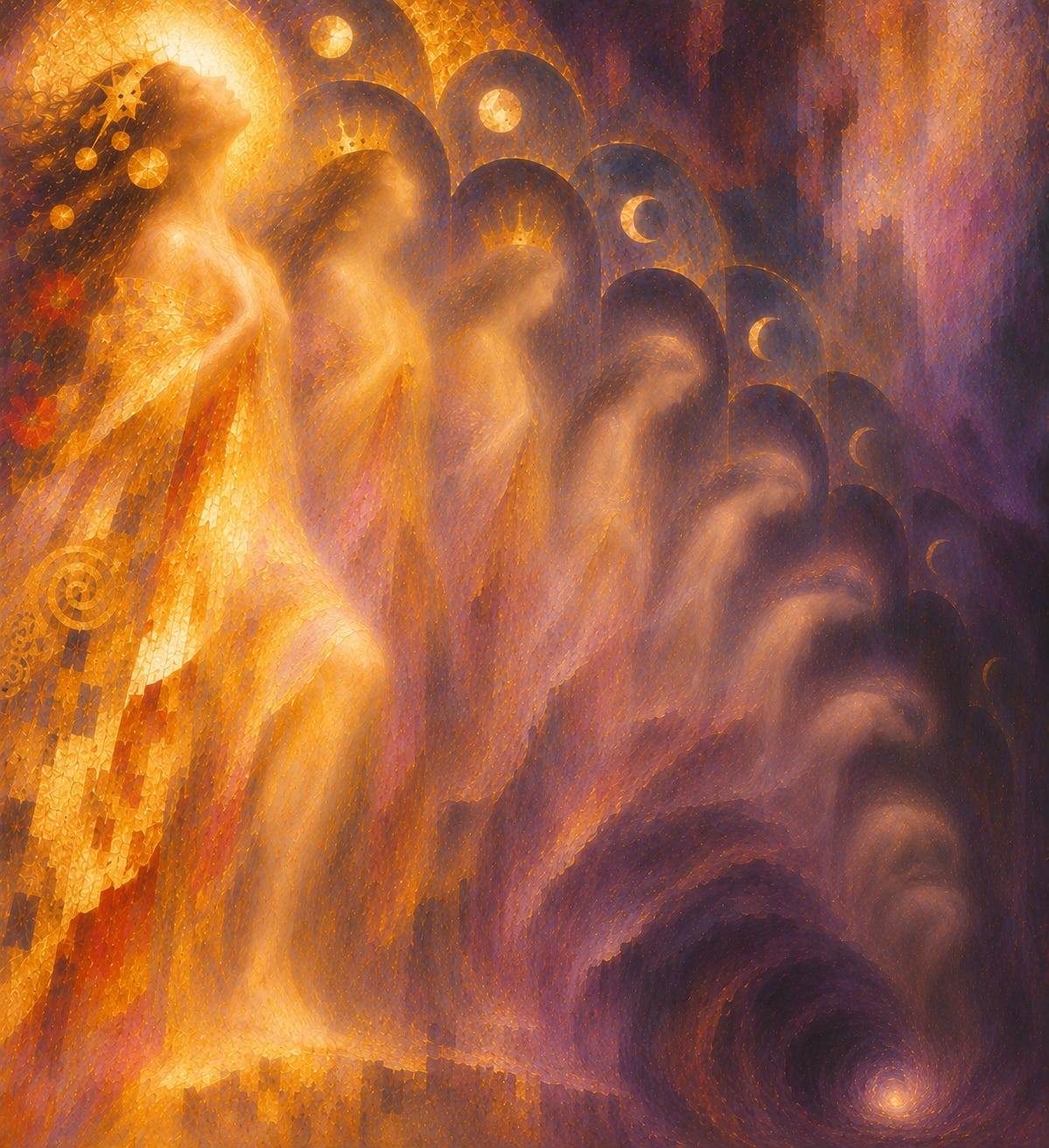
I have seen how meaning ennobles even the most profound descents, including the descents of those with a terminal illness. Indeed, when I first started working as a hospice chaplain, it was somewhat surprising to see just how ripe the theme of initiation was for people at death’s door. How could something be commencing when everything was falling apart?
And yet, day after day in my work as a hospital and hospice Chaplain, initiatory themes emerged from my dialogues with patients. Many patients who were weeks or days away from death had vivid dreams of commencing a journey. Others would have daytime hallucinations of needing to pack for a trip. More times than I could count, patients with various forms of dementia would attempt to leave their beds, exasperatingly explaining to their family that it was “time to go” — “to the train station,” “to the airport,” “to the car.” Those who were conversant would, of course, express their fear of losing control of their bodies, or would describe the inconsolable sadness of saying goodbye to loved ones; but many would also speak of the “adventure” of “what was coming next,” even when they didn’t know what that might be. Over several years I couldn’t help but see the pattern: as we approach physical death, it seems the relative ego does indeed know it will descend and dissolve; and yet, all the while, it’s as if a deeper aspect of the psyche intuits and initiates a journey to an unknown destination.
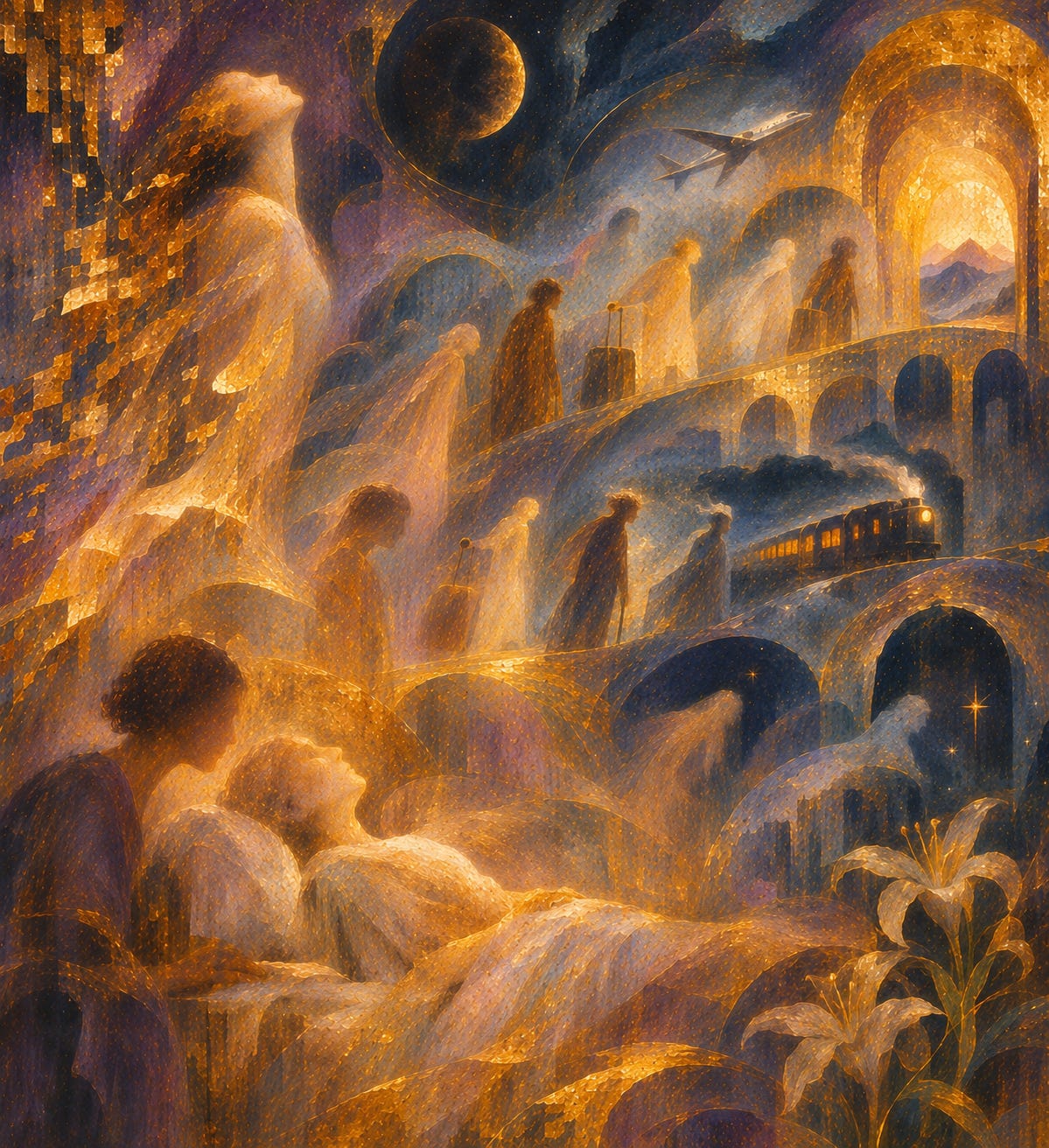
Matt was a patient I visited only a few times before he died, but the details of our time together have stayed with me. When we met, he was exactly my age (comparably young for a hospice patient). With great self-assuredness, he chose to forego most painkillers to stay as alert as possible to his experience, which, frankly, wasn’t pleasant. I both marveled and churned at how calmly Matt would pause our dialogues to vomit bloody bile into a bucket. The nature of his illness made the time from diagnosis to death remarkably short — just a couple of months — but he had somehow come to some rapid acceptance.
When I asked him his secret, Matt shared that, in his short life, he had repeatedly seen that “even the best new things often start with a terrible-letting-go.” He explained that he always found himself discovering something “grander” in each new version of himself. Matt had no specific religious beliefs of what would happen after death, but he did consider himself “spiritual” and often said he would find out what was “on the other side” when the journey reached its “new iteration.” He seemed clear there would be “no more Matt;” but at the same time, his initiatory language pointed to life’s deeper continuation, even if he had no idea what form that life would take.
It’s not that Matt didn’t feel frightened. He did. He was also supremely sad to say goodbye to his wife — his childhood friend and soulmate. But, with a soft and gentle confidence, he trusted an archetypal reality pattern that had undergirded so many of his previous experiences of letting go and re-invention. He was able to trust that the death of his physical body was one more journey toward expansion into something illuminating — into something he did not know before. When I reflected back to Matt, “It sounds like you have trust in this initiation because you have been initiated countless times before,” Matt simply nodded with quiet acknowledgment. Thereafter, every time he would reach for his bucket, he’d calmly say, “just another part of the initiation, Malika.”
Survival Not Guaranteed
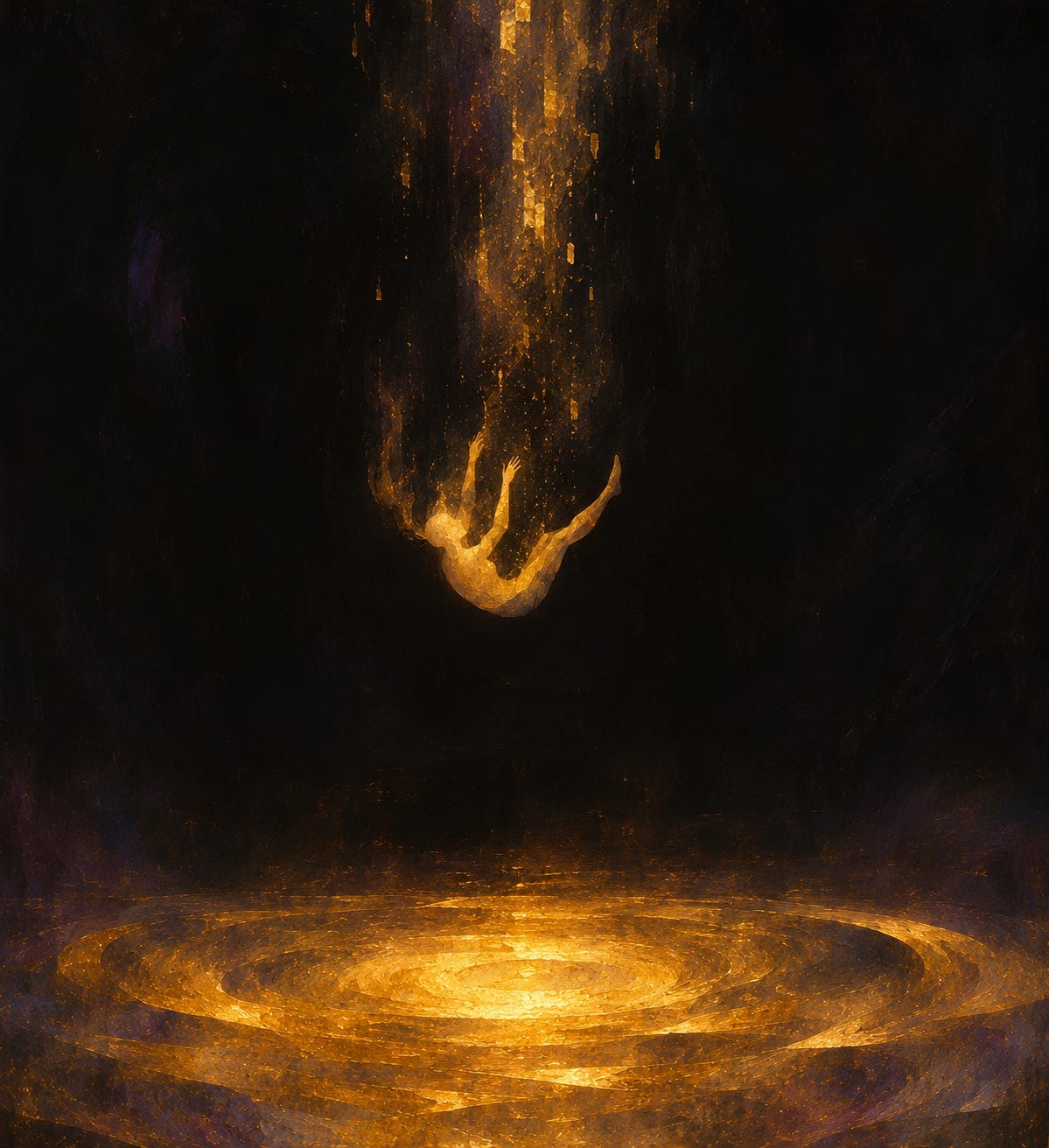
Descent is an experience of dissolution and liminality, but one that has a larger cosmic arc that insists on new life. Whenever I point this out, it can sound “Pollyanna,” so I want to be very clear. Ranging from uncomfortable to harrowing, descents are a dramatic collapse of the old order. This means that, on the relative level, there really is a death. A stage of life, a part of the personality, one’s spirituality, or the physical body really does die. There is no guarantee of physically surviving an individual descent, just as there is no guarantee that the human species will exist beyond this collective descent. Whatever is to come is not known, and it can feel brutal and dizzying to endure the bardo of ambiguity.
But relative death is not the same as nihilistic annihilation. Just as waves arise and dissolve without destroying the oceanic abundance of life, so too creations manifest and die within a larger network of ongoing existence. Knowing this makes all the difference. When we know, even conceptually, that descent is part of a larger cosmic rhythm, we have a chance to see through the illusion of finality and unlock the meaning, beauty, and wisdom embedded in the experience. Life-death-life and initiation are always at play when we contextualize descent in its wider, primordial backdrop. Change is ever afoot, but transformation is what is possible when we receive the cosmic rhythm rather than fight it. As best as we can, we align ourselves to the transpersonal pulse that nature whispers to us, and that so many scriptures, myths, and folktales point to again and again.
Life-death-life-death-life-death-life…
Does it really end here?
Are you sure?
Why not accept the initiatory invitation?
Why not descend like the sages?
Why not fall
to
the
bottom
and
see
what’s
there?
Beautifully written and spoken (and thank you for the audio option - your voice lends an entirely new depth of dimension to the storytelling 💞) - this was the medicine I needed today.
If only everyone could have a map - what a blessing to know there is one. Thank you, as always, for the wisdom you generously share 🙏🏼 Onward into life-death-life!